
An influencer perfume launch is a small-batch economic problem: low volumes, stock packaging, one hero scent and a margin that has to survive the influencer's cut and the platform's fees. The cost model that works for a big brand misleads at this scale, because tooling, testing and paperwork that amortise across a million units sit heavily on ten thousand. Plan the unit cost from the lines that do not shrink with volume, and the launch stays profitable.
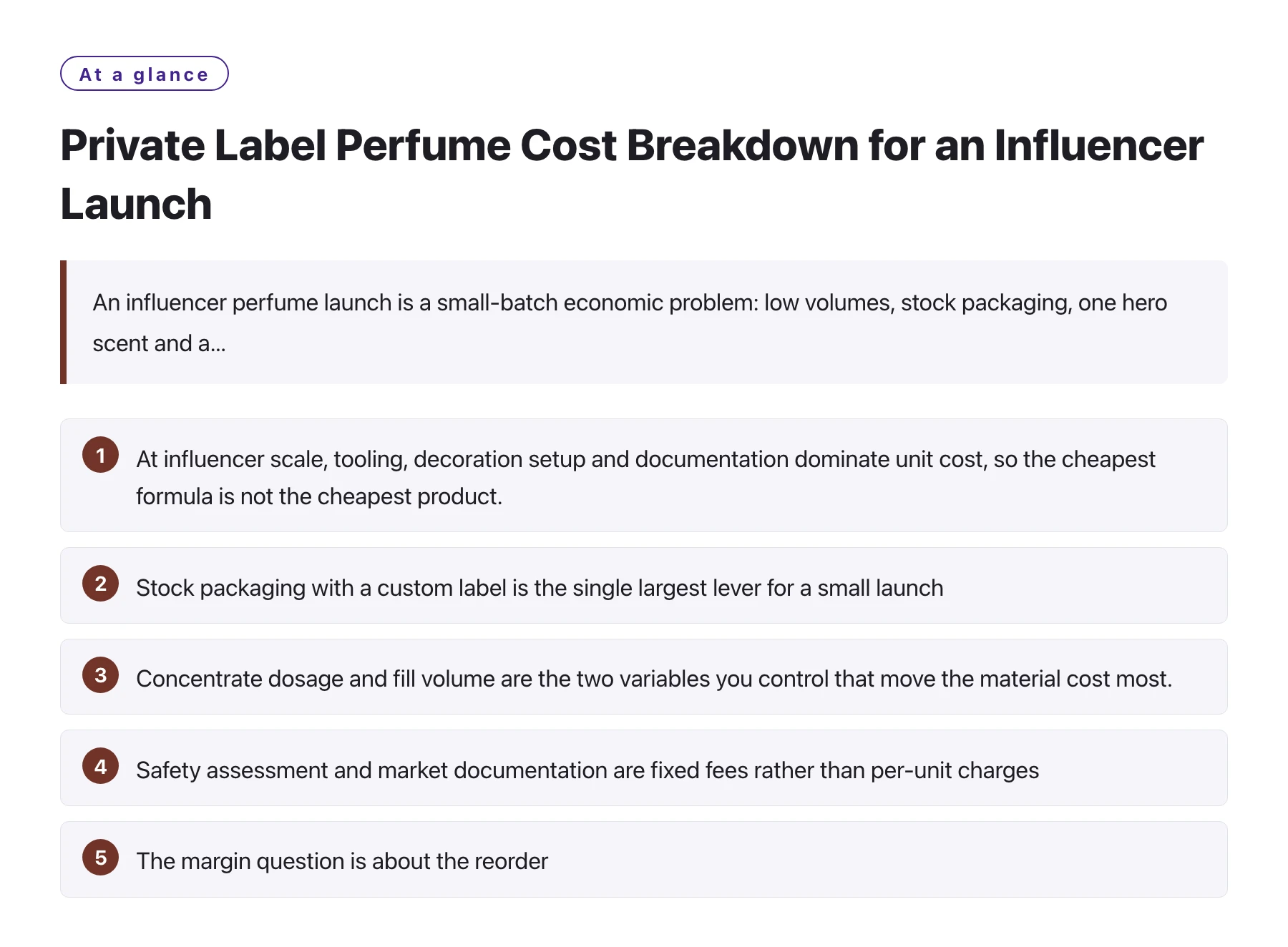
Key takeawaysAt influencer scale, tooling, decoration setup and documentation dominate unit cost, so the cheapest formula is not the cheapest product. · Stock packaging with a custom label is the single largest lever for a small launch, because it removes the tooling line entirely. · Concentrate dosage and fill volume are the two variables you control that move the material cost most. · Safety assessment and market documentation are fixed fees rather than per-unit charges, so testing belongs in the budget as a line, not as a percentage [1]. · The margin question is about the reorder, not the first run: fixed costs are paid once, and the second batch is where an influencer launch makes its money.
A fragrance launch through an influencer is a different cost model from a retail launch. The volumes are smaller, the window is shorter, and the unit cost that matters is the one after the influencer's fee and the platform's take.
This is a line-by-line breakdown of what that unit cost is made of, and the decisions that move each line when the order is measured in thousands rather than millions.
The cost lines that do not shrink with volume
Every private label perfume has the same skeleton: development, concentrate, bottle, closure, decoration, filling, testing, documentation, packaging and freight. The behaviour of those lines splits into two groups: the ones that scale with volume and the ones that do not.
The scaling lines — concentrate, bottle cost per unit, filling labour — behave predictably. The fixed lines — tooling, decoration setup, safety assessment, market documentation — do not, and at influencer scale the fixed lines dominate. That is the whole problem in one sentence.
The number of units does not change the price of a mould, a safety assessment or a market file, which is why the same product can carry a very different unit cost in a first run of five thousand and a reorder of fifty thousand.
Why the fixed lines decide everything
A big brand spreads the mould and the paperwork across a year of production. An influencer launch pays for all of it in one small order, so the product is only viable if the fixed lines are kept small or removed. That is the lens for every decision below.
The line that is not on the quote
Freight, customs and the margin between the quoted unit price and the price on the launch page are real cost lines, and they are rarely on the factory's quotation. For a small launch they can be the difference between a profitable drop and a loss leaders sale, so they belong on the brand's own breakdown [1].
The unit cost, line by line
| Cost line | What drives it | The influencer-scale lever |
|---|---|---|
| Fragrance development | Brief complexity, number of rounds, exclusivity | Start from an existing direction instead of a fully new accord |
| Concentrate | Dosage, ingredient cost, use limits [2] | Right-size the dosage; a lighter concentration suits a launch that sells on story |
| Bottle | Stock versus bespoke, weight, finish | Stock bottle: no tooling, short lead, and the label carries the brand |
| Closure and pump | Component standard and sourcing | Standard components from the supplier's catalogue |
| Decoration | Setup cost, minimum runs, reject rate | One colour label or one print pass; skip foil and multi-pass at small volume |
| Filling and assembly | Line time per unit | One format and few SKUs keep changeovers out of the price |
| Testing and documentation | Fixed per product and per market | Treat as a line item and ask which markets it already covers |
| Packaging and freight | Carton weight, pallet efficiency | Flat-pack cartons and one consolidated shipment |
Read the third column as the negotiation script: at influencer scale, every line you can keep standard is a line that does not multiply with your small volume.
Three decisions that move the total
Three choices dominate everything else, and all three are made before the first sample rather than after the quote.
Stock packaging versus bespoke
This is the largest choice in the whole project. A bespoke mould adds a tooling fee and a longer lead before the first unit exists; a stock bottle from the supplier's range adds nothing but your label. For a launch measured in thousands of units, the stock route is usually the difference between a product and a prototype.
One SKU or a range
Three scents in three bottles multiply every fixed line — testing, documentation, decoration setup — by three while the volume stays small. An influencer launch that sells one hero scent in one format spends its fixed budget once, and the margin shows it.
Exclusivity and the ODM shortcut
If the manufacturer develops the scent from existing directions, development cost drops and time to sample shrinks. Exclusivity on a shared base is payable and worth asking about, because a scent your audience can find elsewhere undercuts the point of the launch. A partner with Xuelei Fragrance will usually say plainly which bases are shared and what exclusivity costs.
Building the breakdown that survives a reorder
The first run pays the fixed costs; the second run does not. A launch price built on first-run cost looks expensive, and a reorder price built on first-run cost looks cheap, so plan both before the first order: ask the supplier to quote fixed lines once and variable lines per unit.
That split is also what makes two quotes comparable. Suppliers answering the same brief will differ most in the fixed lines, and an influencer launch should choose on the reorder economics, not on the first-run total.
Ask each candidate how it separates the two columns. A manufacturer used to working with Xuelei alongside the same client brief will have the split ready, because the split is how its own catalogues are priced.
For a launch this size, a private label partner for perfume lines that standardises components and documentation is what keeps the unit cost sane while the volume stays small — and the fixed-variable split is the single page that tells you whether it does.
Ask for the quote in two columns: one-time costs and per-unit costs. Every line in the first column is a bet on volume, and at influencer scale the only safe bet is the second column.
Sources
- SGS: Cosmetics, Personal Care & Household Testing —— Testing, inspection and certification services for cosmetics and personal care, including microbiological, stability and safety testing aligned with cosmetics GMP.
- IFRA Standards Library (International Fragrance Association) —— The IFRA Standards Library lists the restrictions the fragrance industry applies to individual fragrance ingredients, based on safety assessments; it is the reference point for compliant fragrance formulation.
Frequently asked questions
What is the cheapest way to launch a perfume with an influencer?
Stock packaging, one scent, one format, existing development directions and standard components. Removing the bespoke lines — tooling, multi-pass decoration, multiple SKUs — is worth more than negotiating the concentrate price.
Why is my unit cost higher than a big brand's retail price?
Because you are comparing a small run to a long run. Tooling, testing and documentation are paid once, and a big brand amortises them over hundreds of thousands of units. The comparison that matters is your unit cost at launch versus your unit cost on the reorder.
How many units should the first run be?
Enough to cover the fixed costs without betting the margin: usually the smallest batch the supplier will quote at a sane per-unit price, sized to the audience you can actually reach. A small sellout is a better story than a large write-off.
Can I change the bottle between the first run and the reorder?
Theoretically, but every change re-opens a fixed line — artwork, testing, documentation. Keep the first two runs identical and treat the bottle as a marketing decision for year two, not month two.
Does ODM development make sense at influencer scale?
Often yes: development from existing directions removes the largest fixed development line and shortens the timeline, and exclusivity can be negotiated if the scent is the hook of the launch.