
What 65, 260 and 650 TH/s Look Like Inside a PPS+ Account
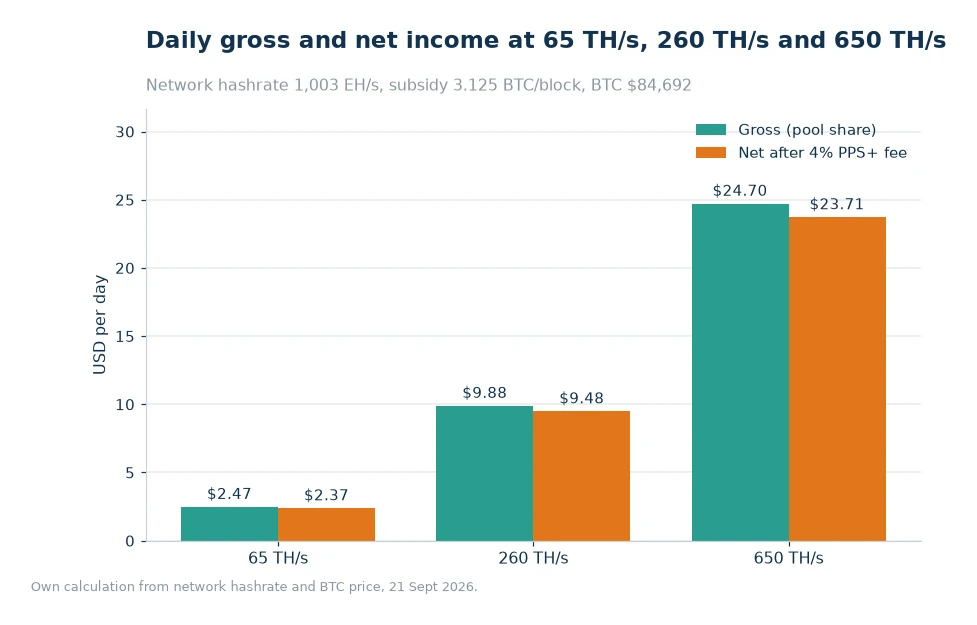
Three machines of different sizes can share one login and still be told apart, which is the practical argument for worker names. At 65 TH/s the account credits roughly 0.00002916 BTC a day, $2.47 gross and $2.37 net; at 260 TH/s it is $9.88 and $9.48, and at 650 TH/s it is $24.70 and $23.71. The hourly line is where the differences show up first.

Key takeaways
- 65 TH/s earns 0.00002916 BTC a day, $2.47 gross and $2.37 net at the listed 4%.
- 260 TH/s is four times that hashrate and 650 TH/s is ten times it, with credits in the same ratio.
- PPS+ settles hourly against current difficulty, so each worker shows a small credit every hour.
- Hourly credits make a failing machine visible within a day instead of at month end.
One login, three credit rates
A pool account is a container for workers. Each worker is a name attached to a hashrate stream, and each stream earns at its own rate. The account total is the sum; the worker breakdown is the only place where a problem is diagnosable. That is why the first decision after creating an account is not how much to mine but how to split the machines into names.
With three sizes on one login, the split is obvious: one worker per machine, named for the model and the location. The 65 TH/s unit might be shed-a, the 260 TH/s unit hall-b, the 650 TH/s unit hall-c. Six months later, when one of them starts losing shares, the name is the difference between a ten-minute check and an afternoon of guesswork.
The hourly line, tier by tier
Because the default plan settles every hour, a day of credits is 24 small entries rather than one large one. The table converts the daily figures into the numbers an operator actually sees on the screen, including a weekly total for budgeting.
| Worker | BTC per day | BTC per hour, net | USD per day, net | USD per week, net |
|---|---|---|---|---|
| 65 TH/s | 0.00002916 | 0.00000117 | $2.37 | $16.59 |
| 260 TH/s | 0.00011665 | 0.00000467 | $9.48 | $66.36 |
| 650 TH/s | 0.00029163 | 0.00001167 | $23.71 | $165.97 |
The hourly column is the one to memorise for the machine you own. A 650 TH/s worker should add about 0.00001167 BTC every hour. If an hour passes with a smaller credit, check the effective hashrate before assuming the pool made a mistake; if two or three hours pass that way, the machine is probably throttling or has lost a board.
Two fees, two different jobs
PPS+ charges a listed 4% against the block-reward portion and a listed 2% against the transaction-fee portion. The split exists because the two components carry different uncertainty. The subsidy is predictable in size and timing; the fee pool is not. Charging the higher rate to the predictable part is what buys the miner an hourly credit that does not swing with pool luck.
The PPLNS alternative combines both components at a listed 2%, settles after six confirmations, and measures each miner's slice across the last five difficulty rounds. On paper the rate is lower. In practice the credit varies with how the pool's blocks land, which is why some operators prefer the flat hourly line even at a higher headline fee. The fee schedule lays out both without ambiguity.
Should the machines share a worker?
Pooling three machines under one worker name is simpler to set up and worse to diagnose. The hashrate graph becomes an average, and an average hides a failure. Two machines at full speed and one at half speed look almost normal on a combined line. Separate workers turn the same event into a visible step.
There is one case for a shared name: a group of identical machines in one rack that are maintained together and always fail together, such as a batch with the same firmware. Even then, the shared name costs you the ability to attribute a shortfall to a single unit, and the saving is a few minutes of setup. The ViaBTC Mining Guide covers the naming screen if the field labels are new to you.
When a credit does not match the table
Short windows are noisy. A single hour can land a few percent above or below the expected figure because shares arrive in bursts and the difficulty used for settlement is the current one, not an average. Three consecutive hours outside a 5% band is worth investigating; one hour is not.
Check in this order: reported hashrate on the machine, effective hashrate on the pool, then the fee line on the credit entry. The first two isolate a hardware or network problem. The third catches a configuration error, such as a worker pointing at PPLNS while the operator expects hourly credits. Most surprises are configuration, and configuration is cheaper to fix than hardware.
Reading the first week without overreacting
The first seven days of a new account are a calibration period, not a verdict. Difficulty can move, the price can move, and the machine's own thermal behaviour settles over several days. Record the daily total each morning and compare it with the figure your hashrate implies. A single strong day is not evidence of anything, and a single weak one is not either. The ViaBTC Mining Calculator gives the expected number for each worker; the variance against it is the only signal that matters in week one.
Do not change the fee plan during that week. Switching plans mid-stream makes the two weeks incomparable and teaches nothing. Pick the plan that matches how you want to be paid, run it for a full difficulty epoch, and judge it on the total rather than on the best single day. A plan that looks worse for one week may look better over three, because settlement timing and pool fee income move together.
Worked example
Take the 260 TH/s worker and derive everything on the table from the network total.
- Share of the network: 260 ÷ 1,003,000,000 = 0.0000002592.
- Daily coin output: 0.0000002592 × 450 = 0.00011665 BTC.
- Gross dollars: 0.00011665 × 84,692 = $9.88.
- Net after the listed 4%: 9.88 × 0.96 = $9.48.
- Hourly net credit: 9.48 ÷ 24 = $0.395, which is 0.00000467 BTC.
- Weekly net: 9.48 × 7 = $66.36.
- Scale check: 65 TH/s is one quarter of 260, so 0.00011665 ÷ 4 = 0.00002916 BTC and $9.48 ÷ 4 = $2.37; 650 TH/s is 2.5 times 260, so 0.00011665 × 2.5 = 0.00029163 BTC and $9.48 × 2.5 = $23.70, which matches the $23.71 in the chart after rounding.
Frequently asked questions
Why does my hourly credit fluctuate?
Shares arrive unevenly and settlement uses the difficulty in force at that hour, so individual credits vary by a few percent. Only a run of hours outside a 5% band suggests a real problem.
Can one account hold miners of different sizes?
Yes, and it should. Each machine gets its own worker name, the account total is the sum of the workers, and a shortfall can then be traced to a single unit rather than to the whole account.
Does PPS+ pay on transaction fees the same way?
No. The block-reward portion carries a 4% charge, while the transaction-fee portion follows PPLNS logic at a listed 2% and depends on the pool's actual fee income.
Let the account answer before you add machines
Run the three workers for a full epoch and compare each one's weekly total with its expected figure. If the 65 TH/s unit and the 650 TH/s unit both land within a few percent of the table, the account is configured correctly and the remaining question is whether the margin covers power. That question belongs to the network statistics page and your electricity bill, not to the pool.
Only after both answers are in should another machine be ordered. The account will not flatter a bad site, and it will not hide a good one either.
Sources: ViaBTC pricing and statistics pages[1]. Snapshot of 21 Sept 2026: 1,003 EH/s, 132.76 T, 3.125 BTC every block, 144 blocks daily, BTC $84,692. Published 24 Oct 2026. Credits assume continuous uptime and an unchanged network.