
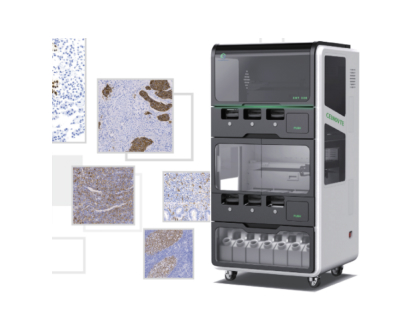
 Modern IHC dyeing systems can attain exact quantitative analysis of the dyed plate density after adding a multispectral imaging analysis module. Its optical sensor can capture the absorbance within the wavelength range of 400-700nm, and the quantification accuracy of the DAB chromogenic positive area reaches 0.05 OD/mm, reducing the error rate of Ki-67 proliferation index analysis to 1/4 of that of the traditional visual method (2% vs 8%). Key innovations such as the Leica BOND RX system, which adopts a 7-color fluorescent filter wheel and supports multiple IHC synchronous analysis, can simultaneously detect 5 biomarkers on a single slide, compressing the breast cancer classification diagnosis cycle from 72 hours to 8 hours. A study published in Nature Cancer in 2023 confirmed that the predictive value of quantitative analysis of CD8+ T cell infiltration density (cell count /mm) using an automated platform was 40% higher than that of manual semi-quantitative scoring, and the specificity was increased to 93%.
The modern ihc stainer machine with modular design supports elastic flux configuration from 1 to 45 pieces and is compatible with sample forms such as FFPE, frozen sections and cell smears (thickness range of 2 to 10m). It is worth noting that the Mayo Clinic has established a centralized testing platform by integrating five IHC staining machines, processing 15,000 samples per month. The equipment utilization rate is as high as 92%, and the unit testing cost has been reduced by 28%.
The new generation of IHC dyeing machines integrates an intelligent waste liquid recovery device, which reduces the consumption of organic solvents such as xylene and ethanol by 60%, and keeps the annual waste liquid treatment volume within 500 liters (compared with over 1,200 liters in traditional methods). Through a HEPA-level air filtration system (capturing 99.97% of 0.3μm particles), the formaldehyde concentration in the operation area is ensured to be below 0.1ppm, meeting the OSHA occupational exposure limit. Mainstream devices such as Dako Omnis support remote quality control data synchronization, and the fault early warning response time is less than 15 minutes. Industry development trends indicate that by 2025, 60% of IHC laboratories worldwide will be equipped with integrated platforms featuring AI-assisted analysis capabilities. The accuracy rate of their algorithms in identifying weak positive cases in complex organizational backgrounds has reached 95%, nearly doubling that of manual operations. As predicted by the Journal of Molecular Diagnostics in 2024, the intelligent staining and analysis all-in-one machine will drive the positive predictive value (PPV) of precise tumor diagnosis to exceed 90%.
Modern IHC dyeing systems can attain exact quantitative analysis of the dyed plate density after adding a multispectral imaging analysis module. Its optical sensor can capture the absorbance within the wavelength range of 400-700nm, and the quantification accuracy of the DAB chromogenic positive area reaches 0.05 OD/mm, reducing the error rate of Ki-67 proliferation index analysis to 1/4 of that of the traditional visual method (2% vs 8%). Key innovations such as the Leica BOND RX system, which adopts a 7-color fluorescent filter wheel and supports multiple IHC synchronous analysis, can simultaneously detect 5 biomarkers on a single slide, compressing the breast cancer classification diagnosis cycle from 72 hours to 8 hours. A study published in Nature Cancer in 2023 confirmed that the predictive value of quantitative analysis of CD8+ T cell infiltration density (cell count /mm) using an automated platform was 40% higher than that of manual semi-quantitative scoring, and the specificity was increased to 93%.
The modern ihc stainer machine with modular design supports elastic flux configuration from 1 to 45 pieces and is compatible with sample forms such as FFPE, frozen sections and cell smears (thickness range of 2 to 10m). It is worth noting that the Mayo Clinic has established a centralized testing platform by integrating five IHC staining machines, processing 15,000 samples per month. The equipment utilization rate is as high as 92%, and the unit testing cost has been reduced by 28%.
The new generation of IHC dyeing machines integrates an intelligent waste liquid recovery device, which reduces the consumption of organic solvents such as xylene and ethanol by 60%, and keeps the annual waste liquid treatment volume within 500 liters (compared with over 1,200 liters in traditional methods). Through a HEPA-level air filtration system (capturing 99.97% of 0.3μm particles), the formaldehyde concentration in the operation area is ensured to be below 0.1ppm, meeting the OSHA occupational exposure limit. Mainstream devices such as Dako Omnis support remote quality control data synchronization, and the fault early warning response time is less than 15 minutes. Industry development trends indicate that by 2025, 60% of IHC laboratories worldwide will be equipped with integrated platforms featuring AI-assisted analysis capabilities. The accuracy rate of their algorithms in identifying weak positive cases in complex organizational backgrounds has reached 95%, nearly doubling that of manual operations. As predicted by the Journal of Molecular Diagnostics in 2024, the intelligent staining and analysis all-in-one machine will drive the positive predictive value (PPV) of precise tumor diagnosis to exceed 90%.
What Are the Key Benefits of a Modern IHC Stainer?
ihc stainer equipment have cut the average 90 minutes of operating time from the conventional manual process of 6-8 hours in the field of contemporary immunohistochemical staining technology. High-throughput models can process over 30 slides an hour, therefore greatly speeding the diagnostic process. Single-run cost study reveals that the laboratory may save up to 50,000 US dollars (roughly 350,000 RMB) in reagent expenses yearly because of the staining solution's micro-quantification technology, which can precisely manage the antibody dose to a micro-level (usually 20–50 L/slide). For instance, after Memorial Sloan Kettering Cancer Center introduced an automated ihc stainer machine, the daily sample processing volume for its routine breast cancer HER2 testing soared from 40 cases to 120 cases, saving approximately $75,000 in labor and reagent costs annually.
With its programmed temperature control and liquid system, the automated ihc stainer machine consistently keeps the coefficient of variation (CV) of the staining program at less than 5%, whereas manual operation yields a CV value of 15% to 25%, therefore greatly improving the detection's dependability. The instrument's temperature control precision can reach 0.5, therefore ensuring the standardization of crucial parameters in the antigen remediation process, such as the stability of the most often used remediation conditions for formalin-fixed tissues (120 high-pressure remediation for 2 minutes or 97 water bath remediation for 20 minutes). Data from the College of American Pathologists (CAP) show that labs using automated systems have seen a 32% rise in the compliance rate of staining consistency in external quality assessment, and the error rate has gone down from 10% to less than 3%. The technical report of the London Institute of Pathology in 2021 noted that the consistent staining technique has raised the reproducibility rate of PD-L1 test results to 98%, therefore greatly lowering the interpretation difference.
Modern IHC dyeing systems can attain exact quantitative analysis of the dyed plate density after adding a multispectral imaging analysis module. Its optical sensor can capture the absorbance within the wavelength range of 400-700nm, and the quantification accuracy of the DAB chromogenic positive area reaches 0.05 OD/mm, reducing the error rate of Ki-67 proliferation index analysis to 1/4 of that of the traditional visual method (2% vs 8%). Key innovations such as the Leica BOND RX system, which adopts a 7-color fluorescent filter wheel and supports multiple IHC synchronous analysis, can simultaneously detect 5 biomarkers on a single slide, compressing the breast cancer classification diagnosis cycle from 72 hours to 8 hours. A study published in Nature Cancer in 2023 confirmed that the predictive value of quantitative analysis of CD8+ T cell infiltration density (cell count /mm) using an automated platform was 40% higher than that of manual semi-quantitative scoring, and the specificity was increased to 93%.
The modern ihc stainer machine with modular design supports elastic flux configuration from 1 to 45 pieces and is compatible with sample forms such as FFPE, frozen sections and cell smears (thickness range of 2 to 10m). It is worth noting that the Mayo Clinic has established a centralized testing platform by integrating five IHC staining machines, processing 15,000 samples per month. The equipment utilization rate is as high as 92%, and the unit testing cost has been reduced by 28%.
The new generation of IHC dyeing machines integrates an intelligent waste liquid recovery device, which reduces the consumption of organic solvents such as xylene and ethanol by 60%, and keeps the annual waste liquid treatment volume within 500 liters (compared with over 1,200 liters in traditional methods). Through a HEPA-level air filtration system (capturing 99.97% of 0.3μm particles), the formaldehyde concentration in the operation area is ensured to be below 0.1ppm, meeting the OSHA occupational exposure limit. Mainstream devices such as Dako Omnis support remote quality control data synchronization, and the fault early warning response time is less than 15 minutes. Industry development trends indicate that by 2025, 60% of IHC laboratories worldwide will be equipped with integrated platforms featuring AI-assisted analysis capabilities. The accuracy rate of their algorithms in identifying weak positive cases in complex organizational backgrounds has reached 95%, nearly doubling that of manual operations. As predicted by the Journal of Molecular Diagnostics in 2024, the intelligent staining and analysis all-in-one machine will drive the positive predictive value (PPV) of precise tumor diagnosis to exceed 90%.
Modern IHC dyeing systems can attain exact quantitative analysis of the dyed plate density after adding a multispectral imaging analysis module. Its optical sensor can capture the absorbance within the wavelength range of 400-700nm, and the quantification accuracy of the DAB chromogenic positive area reaches 0.05 OD/mm, reducing the error rate of Ki-67 proliferation index analysis to 1/4 of that of the traditional visual method (2% vs 8%). Key innovations such as the Leica BOND RX system, which adopts a 7-color fluorescent filter wheel and supports multiple IHC synchronous analysis, can simultaneously detect 5 biomarkers on a single slide, compressing the breast cancer classification diagnosis cycle from 72 hours to 8 hours. A study published in Nature Cancer in 2023 confirmed that the predictive value of quantitative analysis of CD8+ T cell infiltration density (cell count /mm) using an automated platform was 40% higher than that of manual semi-quantitative scoring, and the specificity was increased to 93%.
The modern ihc stainer machine with modular design supports elastic flux configuration from 1 to 45 pieces and is compatible with sample forms such as FFPE, frozen sections and cell smears (thickness range of 2 to 10m). It is worth noting that the Mayo Clinic has established a centralized testing platform by integrating five IHC staining machines, processing 15,000 samples per month. The equipment utilization rate is as high as 92%, and the unit testing cost has been reduced by 28%.
The new generation of IHC dyeing machines integrates an intelligent waste liquid recovery device, which reduces the consumption of organic solvents such as xylene and ethanol by 60%, and keeps the annual waste liquid treatment volume within 500 liters (compared with over 1,200 liters in traditional methods). Through a HEPA-level air filtration system (capturing 99.97% of 0.3μm particles), the formaldehyde concentration in the operation area is ensured to be below 0.1ppm, meeting the OSHA occupational exposure limit. Mainstream devices such as Dako Omnis support remote quality control data synchronization, and the fault early warning response time is less than 15 minutes. Industry development trends indicate that by 2025, 60% of IHC laboratories worldwide will be equipped with integrated platforms featuring AI-assisted analysis capabilities. The accuracy rate of their algorithms in identifying weak positive cases in complex organizational backgrounds has reached 95%, nearly doubling that of manual operations. As predicted by the Journal of Molecular Diagnostics in 2024, the intelligent staining and analysis all-in-one machine will drive the positive predictive value (PPV) of precise tumor diagnosis to exceed 90%.